


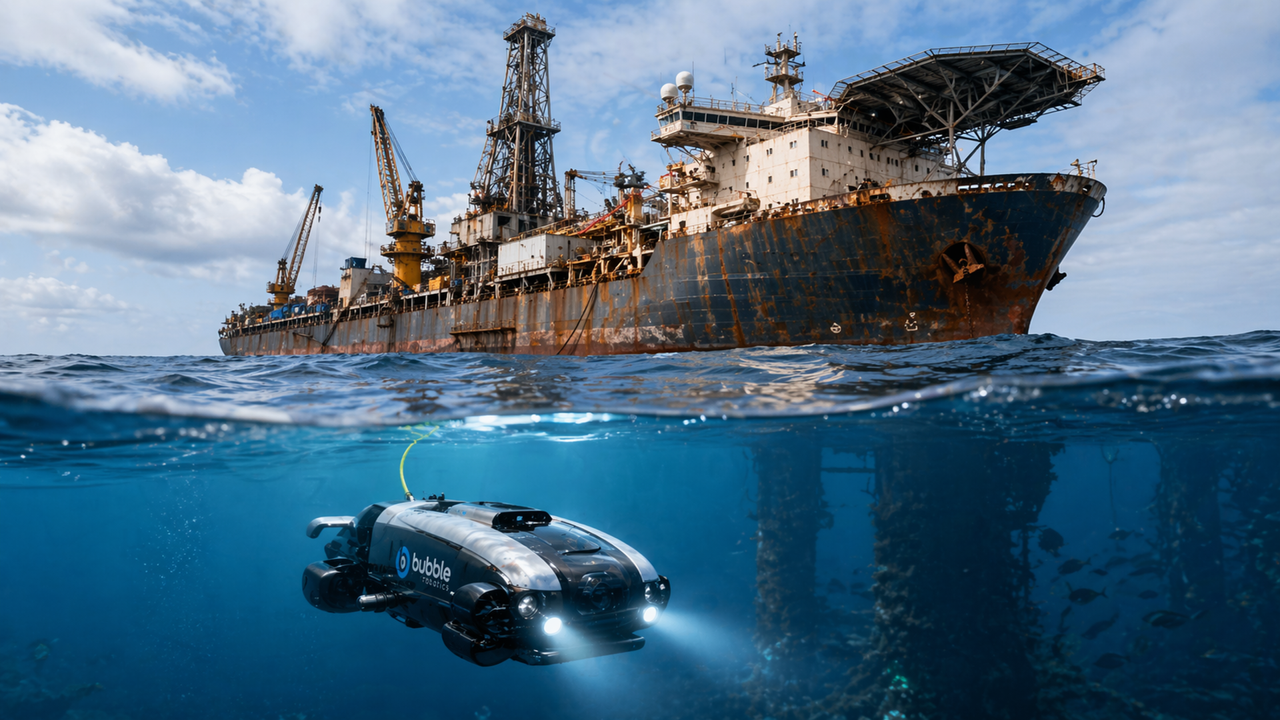
Offshore inspections are still expensive because they depend heavily on vessels and crews, with daily costs reaching up to $100,000. That makes these operations costly, risky, and hard to scale.
Bubble Robotics, a startup founded by former robotics engineers from NASA and ETH Zürich, says it has a different approach. The company came out of stealth in April 2026 with $5 million in pre-seed funding and a plan to replace traditional support ships with autonomous robots.
Persistent robots instead of short offshore missions
The company’s core idea is simple: offshore work should not require people to stay at sea. Instead of sending vessels out for brief missions, Bubble Robotics deploys robotic systems that can stay on site for months.
These AI-powered machines inspect equipment, monitor conditions, and collect data continuously without human intervention.
According to Jean Crosetti, CEO and co-founder of Bubble Robotics, 80% to 90% of offshore inspection costs come from vessels and crews. He says removing that dependency could significantly improve cost, safety, and how often inspections happen.
This approach also lines up with a larger labor problem. The energy sector is expected to need another 600,000 workers by 2030, even as the current workforce remains under pressure.
Bubble Robotics uses a robotics-as-a-service model, so customers pay for the capability instead of making large upfront investments or arranging offshore deployments themselves. The company says this can lower costs, ease staffing shortages, and increase inspection frequency.
The opportunity goes beyond industrial inspection. Maritime security is also becoming more important, while subsea cables, ports, and energy infrastructure still lack real-time monitoring in many cases. Persistent autonomous systems could help detect anomalies and protect critical assets without sending human crews into the field.
The technology depends on edge AI and satellite connectivity, which the company says have now reached an important turning point.
Even so, there is still a major question: can these systems really survive and operate for months in harsh ocean conditions without failing?
Bubble Robotics has signed letters of intent worth more than $4 million, which suggests there is market interest. Still, the real test will come when the robots are deployed at scale.
The ocean is central to energy transition, global trade, and climate resilience, but many ambitious marine technologies have struggled against saltwater, storms, and biological fouling. Bubble Robotics may have a strong thesis, but persistent autonomy at sea will need real-world proof, not just a good pitch.